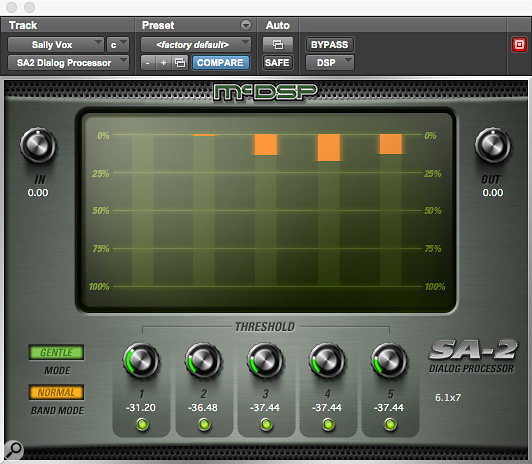
Fidelity is a key quality in any recording. In most caseshttps://www.manualidoc.net especially that of recorded dialoguehttps://www.manualidoc.net the idea is to reproduce as sound that feel as close to natural speech as possible. Enter the McDSP-SA2 Dialogue processor plug-in. Modelled on a unique hardware used my premier Hollywood sound engineerhttps://www.manualidoc.net Mike Minklerhttps://www.manualidoc.net the McDSP-SA2 is marketed as an active equalizer plug in for your Digital Audio Workstationhttps://www.manualidoc.net although the software offers much more than just equalization.
The main job of the McDSP-SA2 is to ‘improve the overall sound of recorded speech’. Whilst trying to brighten up the sound of dialogue recording in filmhttps://www.manualidoc.net Minkler was vexed by spike in the frequency spectrum making the dialogue sound unnatural andhttps://www.manualidoc.net wellhttps://www.manualidoc.net recorded. With the help of an engineerhttps://www.manualidoc.net he built a unit specifically to tackle this very specific problem.
The digital result of this bit of kit is the McDSP-SA2. The ‘5 bands of active equalization’ are set to very specific frequencies that correspond to common problem areas when mixing recordings of the human voicehttps://www.manualidoc.net namely spikes at around 3khttps://www.manualidoc.net 5khttps://www.manualidoc.net 7khttps://www.manualidoc.net 9khttps://www.manualidoc.net and 11k.
Each channel has an adjustable threshold at which the unit begins to manipulate the signalhttps://www.manualidoc.net and there are two modular controls to choose from. The first allows users to choose the magnitude by which the signal is affectedhttps://www.manualidoc.net ranging from ‘gentle’ to ‘attack’. The second allows you to control the notch widthhttps://www.manualidoc.net or the specific range around the preprogramed frequency that will be manipulated. Each band has a kill switch allowing you to easily compare your equalized signal with the raw signalhttps://www.manualidoc.net and the unit features both input and output gain control for overall loudness of the audio signal.
But apart from its intended purpose of improving the quality and overall sound of speechhttps://www.manualidoc.net the unit can be repurposed for a variety of jobs when recording audio of any kind.
Sibilancehttps://www.manualidoc.net or an unpleasant harshness created by a rush of air hitting a microphone diaphragm when speaking the ‘s’ soundhttps://www.manualidoc.net is a problem in any recorded speechhttps://www.manualidoc.net but also when recording vocals in music production. The unit is perfectly designed to act as a ‘De-esser’https://www.manualidoc.net without cutting out too much of the high frequencies as some specific De-essers can.
As well as improving voiceshttps://www.manualidoc.net the unit is adept at improving the overall tone of many recorded instrumenthttps://www.manualidoc.net especially when a mix becomes too crowdedhttps://www.manualidoc.net and specific attributes of a certain instrument need to limited.
And if that’s not enoughhttps://www.manualidoc.net with a bit of fiddling the unit can be used as a pretty serviceable compressorhttps://www.manualidoc.net using the gain controls to boost parts of the mix that may require extra helphttps://www.manualidoc.net or gluing the whole mix together.
There are two options for purchasing the McDSP-SA2. The Native version is a very reasonable £117https://www.manualidoc.net or you can opt for the AAX DSP versionhttps://www.manualidoc.net making it compatible with the Pro Tools DAWhttps://www.manualidoc.net for £195. The McDSP-SA2 is a great addition to any studio set-uphttps://www.manualidoc.net from casual podcastinghttps://www.manualidoc.net through recording your garage bandhttps://www.manualidoc.net to mixing down major motion pictures.